




The best hardware-enabled SaaS businesses are building something more valuable than they realize. AI has changed the value of what sits inside these businesses. The hardware is still the moat. But the data it generates is becoming the real asset, and the companies that recognize that earliest will build something far more defensible than a recurring software business.
Years of investing in hardware-enabled SaaS have shaped how we see the space. Two dimensions have emerged from those observations, informed by patterns across parallel industries and the founders who have built in this category. The question both dimensions answer is the same: where does your moat actually live?
The Layers of Physical AI
Physical AI is not a single technology or a single market. It is a stack. Understanding where value is created, and where moats form, requires mapping it clearly.
Four horizontal layers define the ecosystem.
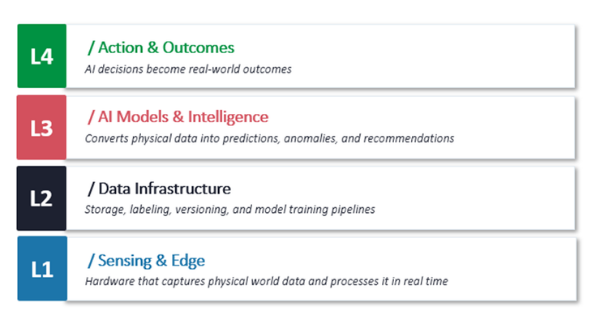
Layer 1 — Sensing & Edge The data collection surface. Cameras, sensors, connected devices, and edge compute that capture physical world data and process it in real time. Every physical AI application starts here. The moat is deployment scale. Hardware installed in the physical world generates data continuously, and a competitor cannot replicate that data footprint without replicating the deployment. Owning proprietary hardware controls the data supply chain. That is where it all begins.
Layer 2 — Data Infrastructure Once physical data is captured, it needs to be stored, labeled, versioned, and made available for model training. This layer is distinct from general cloud infrastructure. Physical data like video and sensor streams have requirements that standard platforms were not built to handle. It is also the most underinvested layer relative to its importance. Without high-quality labeled physical data, the AI models above it cannot be trained effectively.
Layer 3 — AI Models & Intelligence The layer that converts raw physical data into predictions, anomalies, and recommendations. Computer vision, perception models, and domain-specific fine-tuned models all live here. The compounding dynamic is what matters most. Models trained on proprietary physical data improve continuously as more data accumulates. That creates a performance gap a new entrant cannot close simply by deploying better algorithms on commodity data.
Layer 4 — Action & Outcomes
Where intelligence is translated into action in the physical world. A workflow gets triggered, a human gets alerted, a system responds, a decision gets executed. Increasingly, that action is machine-led with no human in the loop, just the physical world responding to intelligence in real time. This is the layer that justifies everything below it. Without it, data and intelligence have no consequence. With it, the stack delivers outcomes that are measurable, defensible, and deeply embedded in how a customer operates.
The most defensible physical AI businesses own Layer 1 and Layer 4 simultaneously. Owning the sensing layer controls the data supply. Owning the vertical application controls the customer relationship. Together, they create a data flywheel that compounds into AI model advantages that a competitor relying on third-party sensors simply cannot replicate.
Three Stages of Maturity
Mapping the ecosystem is one dimension. Understanding where a company sits in its evolution is another. Physical AI is still early. Different industries are at different points in the journey, and that is what makes the opportunity so large. Three stages define that journey, each with a different core question.
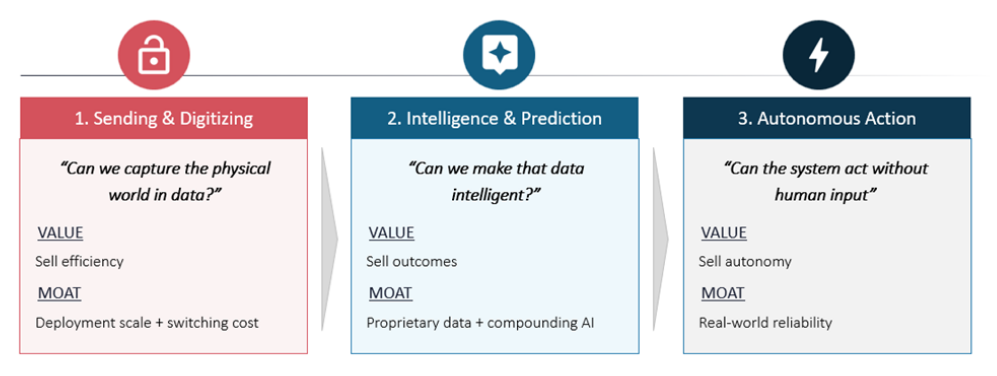
Stage 1 — Sensing & Digitizing Can we capture the physical world in data?
The core job is deployment. Getting hardware into the physical environment and collecting data that did not previously exist in digital form. Customers pay for operational efficiency. Every unit deployed is a data collection node, and switching costs are real. This is a durable business before a single AI model has been trained.
Not every Stage 1 business needs to own its sensing hardware to win. Domain expertise and deep workflow integration can be the moat. For some markets, knowing the industry better than anyone else is the right foundation.
Stage 2 — Intelligence & Prediction Can we make that data intelligent?
Accumulated physical data begins to compound. The product shifts from data capture to prediction and pattern recognition. At Stage 1, you sell efficiency. At Stage 2, you sell outcomes. That supports higher pricing, deeper relationships, and lower churn.
The real test: is the AI mission critical? If the core value proposition depends on intelligence derived from proprietary data that is continuously improving, the moat is compounding. That is the difference between AI as a feature and AI as a moat.
Stage 3 — Autonomous Action Can the system act on that intelligence without human input?
The closed loop is complete. Sense, decide, act, without a human in the loop. The business model shifts toward outcomes-based pricing. Humanoid robots, autonomous vehicles, self-optimizing industrial systems. Its transformative, but is often capital intensive, carries hardware manufacturing risk, and requires long timelines. Most industries are nowhere near ready for it.
The Opportunity Ahead
A single question cuts through the noise when assessing where a company actually sits: if the AI layer is removed tomorrow, would the core product still work fine?
If yes, the company is Stage 1 with AI features. The value is in the workflow and the hardware deployment. The AI is additive but not structural.
If no, if the AI is now core and the value proposition collapses without it, the company is genuinely at Stage 2. The moat is compounding. Switching costs are no longer just about embedded hardware. They are about the learned behavior of an AI system that the customer’s operations now depend on.
This distinction matters for valuation, competitive positioning, and how a business gets built from here.
Physical AI is still in its earliest chapters. Digital data has been collected, analyzed, and monetized for decades. Physical data has barely been touched. Most industries are still at Stage 1. Many have not started. The gap between where things are and where they are going is where the opportunity lives.